Day 24: who left the room 269 times
I left the child alone — in a room, with the door closed, for thirty minutes. The result: this time it got a memory, a real one, written to disk and still there in the morning. So it got a whole night.
The idea is simple: whatever the robot sees, it writes down. Not everything, every frame — that would be about twenty-six million rows a day. Only what matters: a new object, an object that changed, an object that left. Evidence first, conclusions later. Like a night watchman with a notebook.
At two in the morning I moved a mug ten centimeters to the right and left the watchman to it.
The morning report
The mug was caught. Good watchman.
Then nothing happened in the room for five hours. Nothing at all. The light didn’t change, nobody came in, the mug stayed where I’d put it.
The notebook says 293 things left the room that night.
One object alone left 269 times. It started at a quarter to four and then left again every twenty-five seconds, until morning. It hadn’t gone anywhere, as it turned out — more on that below. But once the robot decided its place was empty, it kept looking at the empty place, and every time it saw that the place was still empty, it wrote it down again. Imagine a guard who notices an empty chair and reports it to the boss. Every twenty-five seconds. All night. The boss, in this case, was me.
The fix is one sentence long: something that has gone is not checked again until it is seen again. One sentence, a night of data to find it. And it won its morning coffee!
The wall that ate the mug
That was the funny problem. The serious one was under it.
The robot draws a box around everything it sees, and it decided which thing is which by the boxes: if a new sighting sits inside an old box, it’s the same thing. Sounds reasonable. Now picture the first sighting of a wall. It’s a box too — a very big one. And everything standing in front of the wall sits inside it.
So the wall ate things. Of eighty-four objects that night, thirty were born more than half a meter across: walls, the floor, a door, a bicycle. One of them collected twenty-five different names, because every small thing in front of it was taken for another view of it. The one that left the room 269 times was born this way too.
And the hand. When I moved the mug, my hand stayed in view long enough to become an object. The robot named it “hand.” For once the name was perfectly right — about the one thing that shouldn’t have been in the notebook at all.
My team and I tried every rule a box allows: bigger boxes may hold only smaller ones, only up to a size, only up to a ratio. Each one either chopped real objects into fragments (a hundred objects instead of fifty) or threw away the real big ones. A box simply can’t tell a part from a neighbor. A marker’s cap on its holder and a mug next to a notebook: same gap of four or five centimeters, same share of one box inside the other. One is one thing, the other is two. The box just sits in its bunker — it doesn’t talk, and it has no idea which is which.
Shapes, not boxes
So on the second day we stopped waiting for the boxes to love us back. The camera doesn’t only give a box — it gives the exact shape of every object in the picture, pixel by pixel, and the depth behind each pixel. On a still scene those shapes are very stable: nine of ten match the previous frame almost exactly. So the robot now asks “is this the same shape I saw a moment ago?” instead of “is this inside that box?” A big flat thing more than a meter across is a wall, or a floor, or a table, and it doesn’t get to eat anything. And an object is no longer a box at all, but a little cloud of two-centimeter cubes, built up from everything it has been seen as.
Along the way the depth produced its own small comedy. The edge of an object’s shape picks up the depth of whatever is behind it, so a towel came out 1.3 meters thick and a glass two meters deep, and both were filed as walls. Trimming three pixels off the edge fixed it. Three pixels.
Naming moved too. Instead of asking the language model about every glimpse, the robot now picks five views of the object from across its life and asks twice: once plainly, “what is this?”, and once with the object circled in red, “what is the circled thing?” — like a teacher with a red marker. When both questions give the same answer, the name is trusted. Then it’s right about nine times in ten. Not certain. But a lot better than a tablet with seven names.
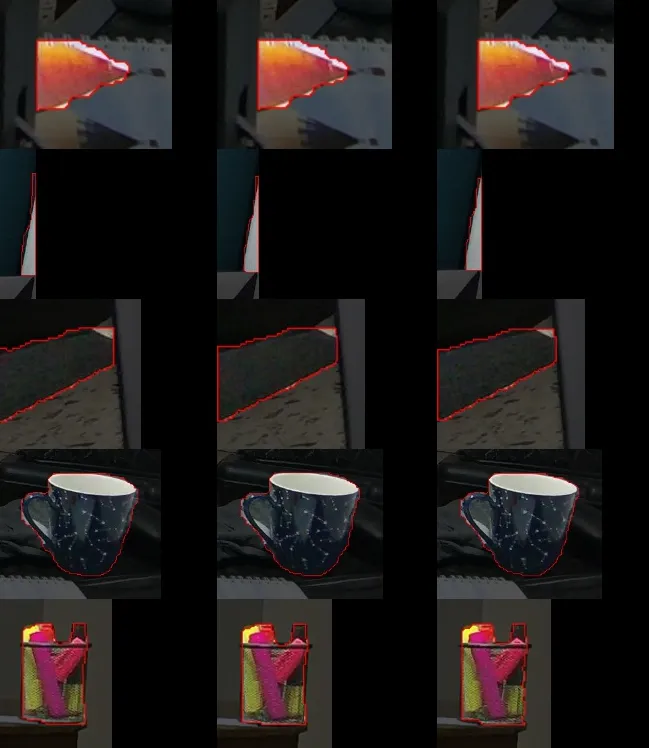
The second question: “what is the thing in red?”
Then came the part nobody automates: checking. I sat with sheets of small pictures, every object with its outlines drawn in, and wrote down what each one really was. The old way had fifty-one objects, fourteen of them seen exactly once, plus two walls with full stomachs. The new way: twenty-eight objects it is sure about, twenty-five of them real, each once. Zero swallowers. All seven of my staged changes caught.
Four false alarms on the still scene, though. Nobody’s perfect. The watchman gets a second night shift to prove the new notebook. Same room, same mug. Fewer departures, I hope. And we’ll see whether it likes its morning coffee…