Day 15: the brain has a body
For two weeks the Jetson has been a loose object. It sat on the desk with cables coming out of it at odd angles, and every time I moved anything on that desk I moved the brain of my robot along with it.
Not anymore.
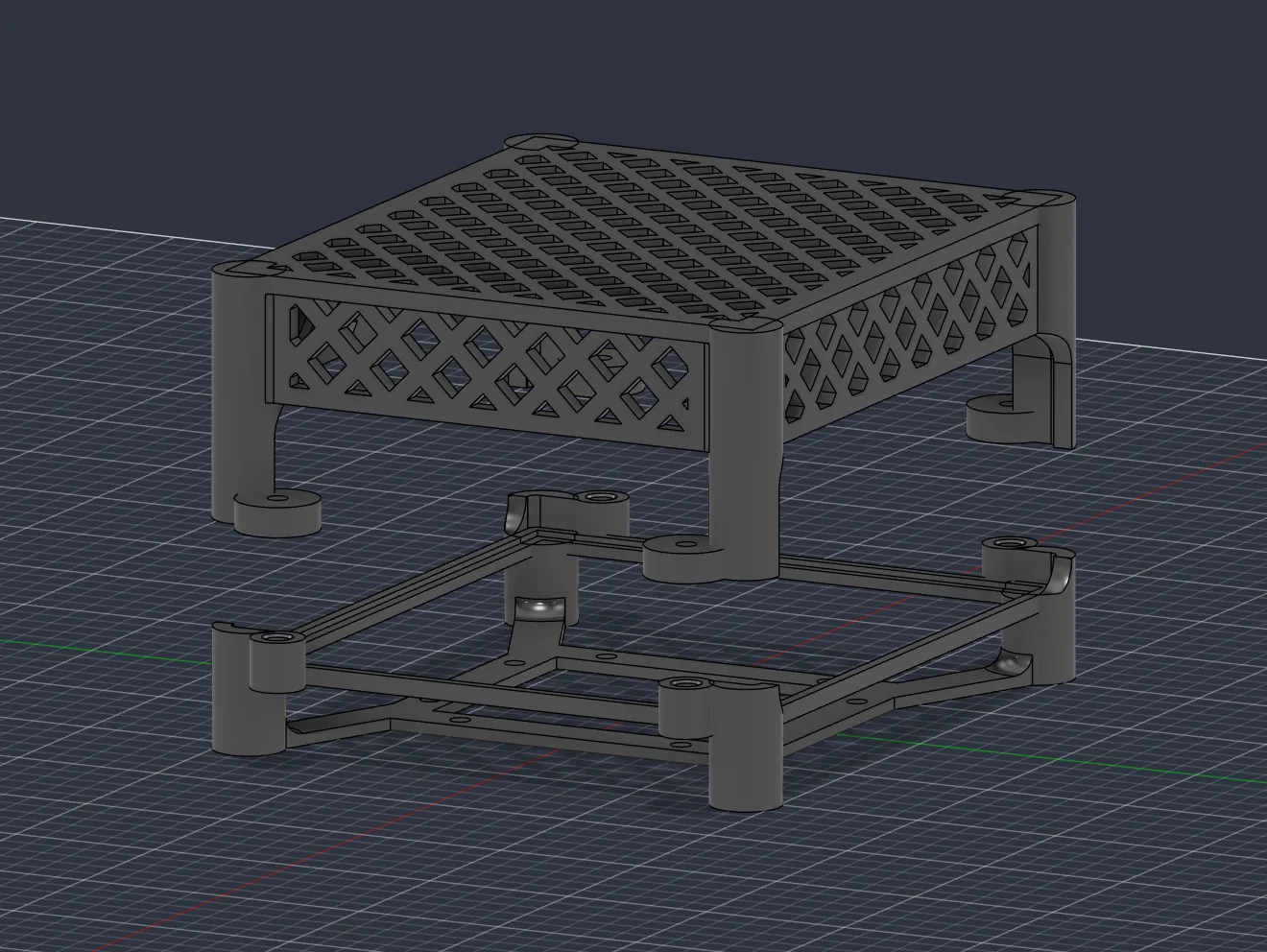 Two pieces. A cradle underneath, a lid over the top.
Nothing to bolt to
The board itself has mounting holes. That isn’t the problem. The problem is that it arrives already fitted into a shell, and the shell has none — and I wasn’t willing to take the shell off a three-hundred-dollar computer to get at them.
So the enclosure can’t attach to the board at all. It has to hold it: cradle it from beneath, catch it around the edges, and grip it without a single fastener touching the thing being gripped.
That changes how you design. With bolt holes you get a second chance — slots, washers, a bit of slop to take up. With a cradle you get one dimension and it’s either right or it isn’t. Every measurement comes from the manufacturer’s drawings and my own calipers, and every one of them has to be right at the same time.
The sensible approach is to print a test corner, try it, adjust, print again. I didn’t do that. I designed the whole thing and sent it to the printer once.
The lattice
The holes started as a thermal requirement — the board has a fan and it needs somewhere to push air — but once the sides had to be mostly gaps anyway, I spent a while on what shape those gaps should be.
It ended up as a grid of small squares across the top and down both sides. It prints cleanly, it doesn’t need support in the places that matter, and it looks like somebody chose it. That last part isn’t engineering, and I don’t care — I’ve been staring at grey CAD shapes for weeks and I wanted the first piece that holds the brain to look like something.
It fits
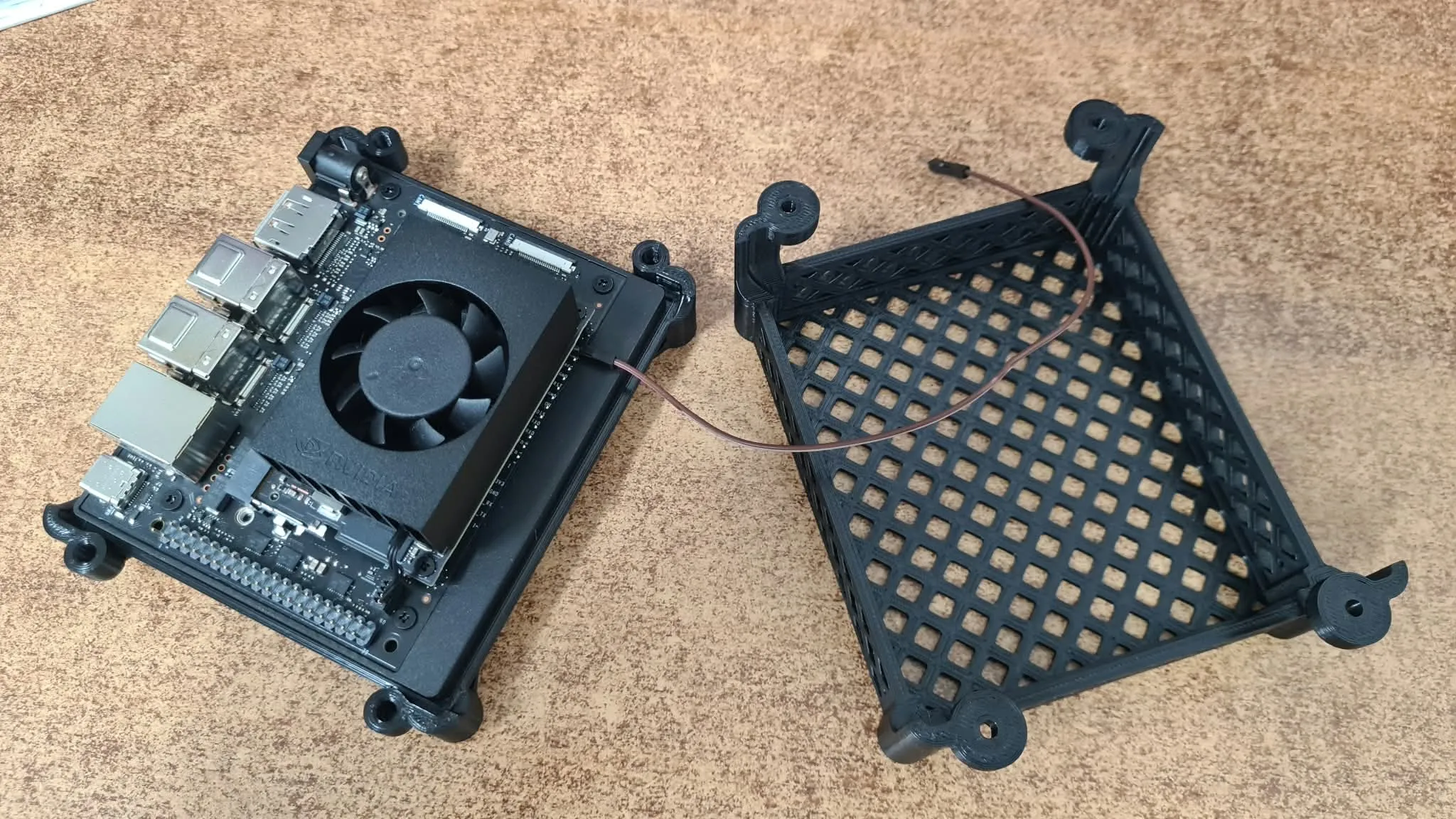 First print. The board went straight in.
Straight in. No filing, no shimming, no pressing one corner and hoping. The edges sit exactly where the drawings said they’d sit.
I’m allowed to be pleased about this one. It’s the first part of this project I designed entirely on my own terms, start to finish, with a clear picture in my head of what it should be — and then it came off the printer and was that thing. The measurements held. The fit held. The lattice looks right in black PETG.
It also happens to be the part that matters most. Everything else on this robot can be re-printed cheaply if it’s wrong. This one holds the expensive part.
Tomorrow
Brass inserts go into the posts — that quick, oddly satisfying press with a hot iron where an empty hole becomes a threaded one. Then the whole assembly gets bolted down to the mounting plate, next to the camera tower, in the spot that’s been reserved for it since the layout drawing.
At which point the brain stops being a thing on my desk and becomes part of the robot.