Day 11: the robot has an eye and doesn't know where it is
Today started as a tidy-up job. The camera came with a tripod, and a tripod is a perfectly good thing, but it means the camera lives somewhere slightly different every time I sit down at the desk. So: bolt it to the plate instead. Half an hour, one printed part, done.
Then I thought to ask — somewhere different relative to what?
That question ate the entire day.
The hole nobody had noticed
Here’s what I hadn’t clocked. The camera spots an object and works out where it is — in the camera’s own frame of reference. Distances measured from the lens. And the code that turns that into “rotate the joint this far” takes those numbers and just uses them.
Nowhere in any of it does anything state where the camera actually is relative to the arm.
So the robot has an eye, and an arm, and no notion whatsoever of how the two are related. Any mirroring it managed would have been a coincidence — the camera happening to sit roughly where the code assumed. Nudge the tripod ten centimeters and everything goes quietly wrong, with no error, no warning, because there was never a measurement there to be violated.
Which reframed the whole job. The mount isn’t the point. The mount is the thing that makes a measurement worth keeping.
Four good ideas, all shot by their own arithmetic
Then I tried to actually design it, and spent the afternoon watching clever ideas get executed one after another by their own numbers.
Keep the tripod’s ball head and bolt that to a printed tower — rigid base, adjustable aim, best of both. Except a ball head holds by friction, and friction creeps. Aim is the half of this that really hurts: one degree off at half a meter is the better part of a centimeter of error. A bolt that works loose rattles and you notice. A ball head that wanders two degrees overnight just hands you confidently wrong numbers forever.
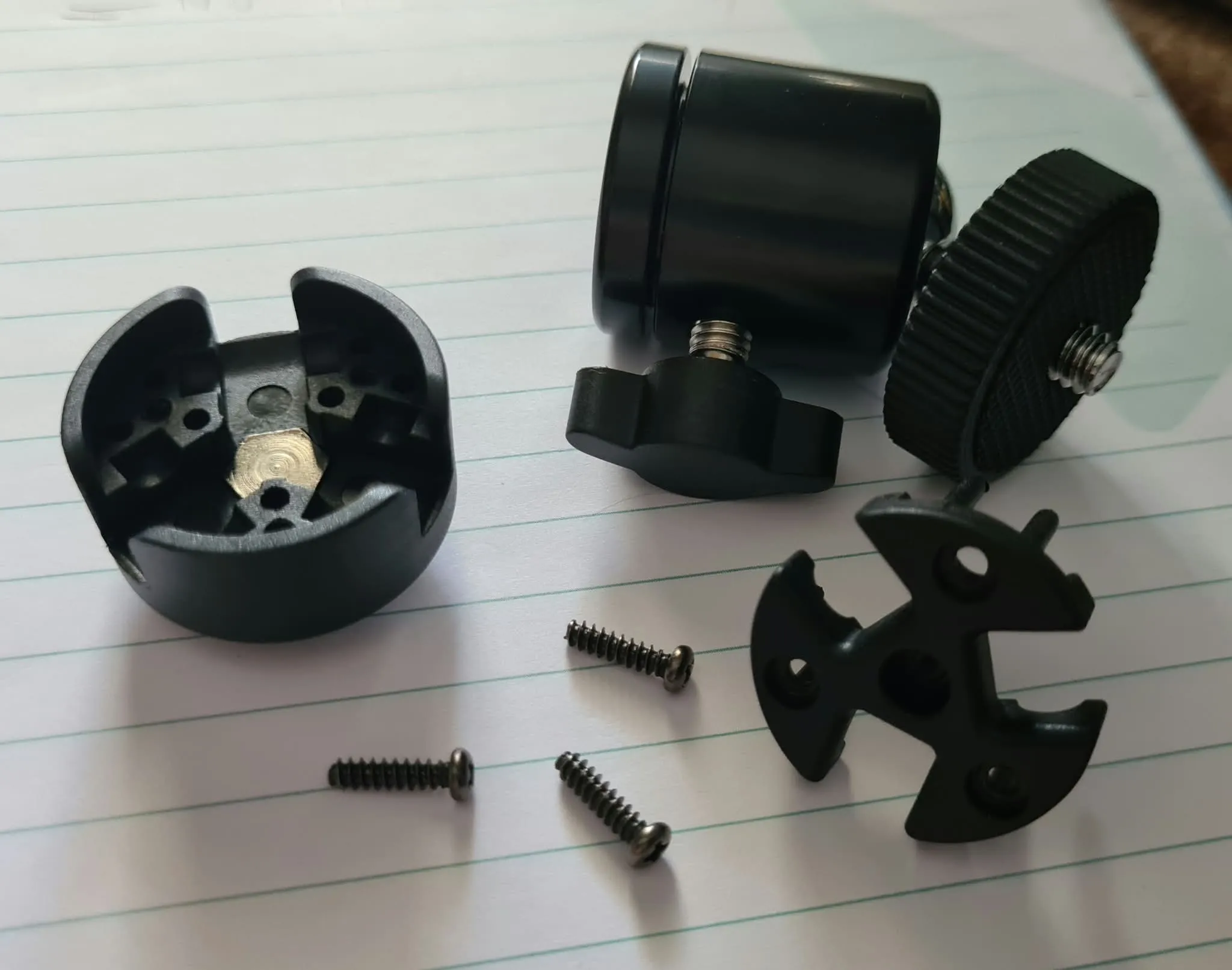 Auditioned, rejected, and disassembled in roughly that order.
Print the tower and the camera bracket as two parts, so if I get the angle wrong I only reprint the small one. Sensible. Then I did the arithmetic on the bolt holes: the clearance around the screws permits about a degree of rotation before any metal touches anything. The exact figure I’d just rejected the ball head over, smuggled back in by my own safer design. One piece, then.
Make the tower tall enough to put the camera beyond its minimum working distance. I’d derived a height for this very carefully. Then noticed I’d applied that constraint to the arm — and the arm isn’t located by depth at all, it’s found by a printed marker in ordinary color vision. The number was solving a problem that didn’t exist. The tower lost nearly half its height and became far stiffer for it, since a shorter post barely flexes when the servo starts shaking the plate underneath.
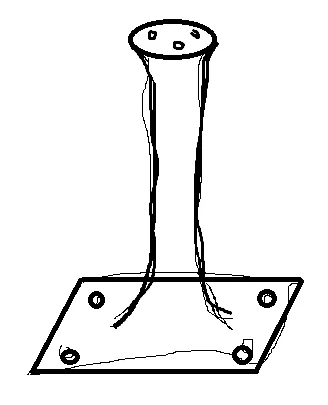 The entire design, in the brief window before arithmetic got involved.
By the end it was one printed piece: a plate, a post, and a pad at the top, with the cable running down inside the post rather than dangling off it.
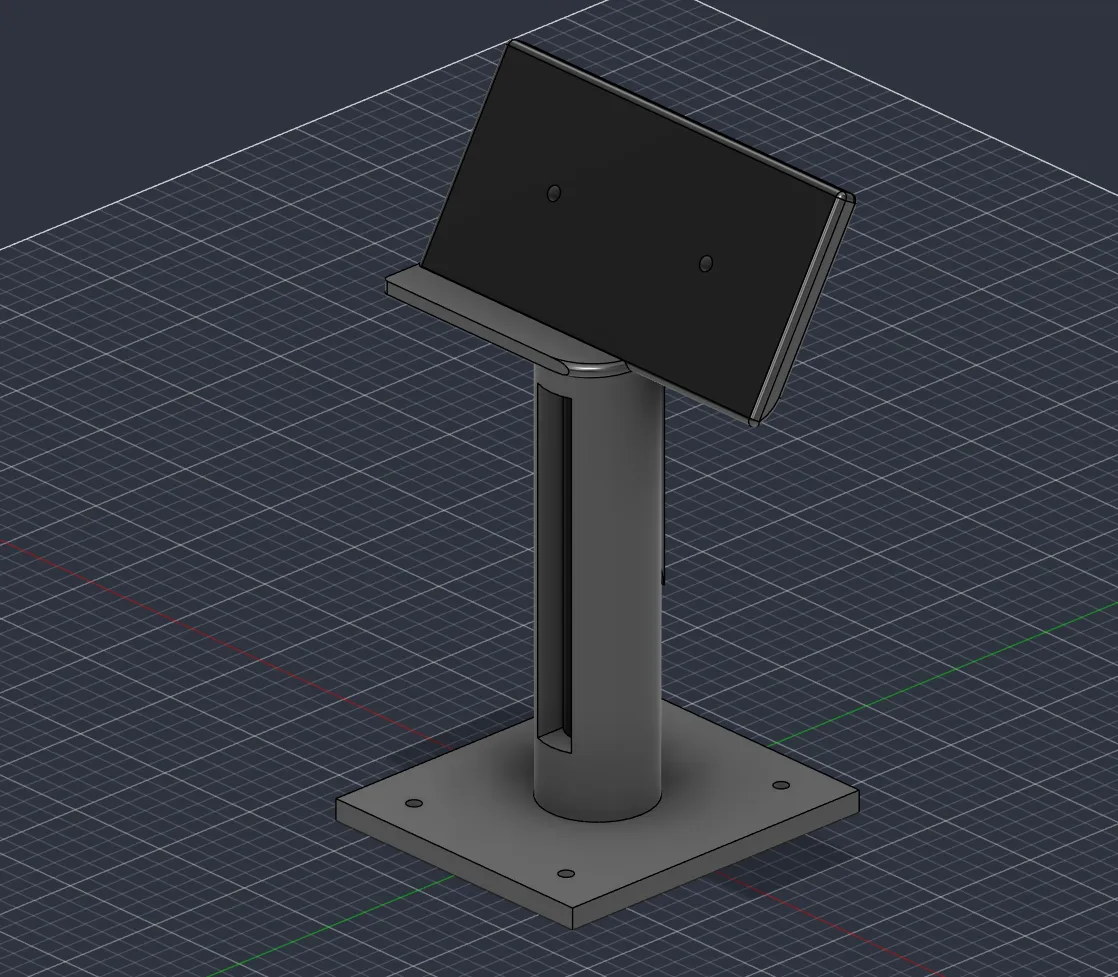 Everything the afternoon didn’t manage to argue me out of.
And then it mounts backwards
One final indignity. The Gemini fixes by its back face — the flat side opposite the lens. Which means if you want it looking forward and slightly downward, the bracket has to sit above and behind it and hold the camera out in front of itself, hanging. Every mental picture I had of “camera on a post” involved the camera sitting on top of something. It doesn’t sit on anything. It dangles.
My team, for their part, built the tower twice — once to a revision I’d already superseded, and once with the mounting face on the wrong side entirely, so the camera would have stared backwards over its own tower at the wall behind. I was drafting a fairly pointed note about this when I reread my own instructions and found I’d described where the material goes and where the screws go in the same sentence. They’d followed it correctly. That one was mine.
The strange loop
So: one mount design, and four separate occasions of being publicly wrong about it.
The part I keep turning over is the last thing I realized. This whole design rests on the premise that a rigid printed tower holds its position. I can’t confirm that by looking at it. The only instrument that can tell me whether the mount works is the calibration routine — the very thing whose job is to measure where the camera is. Run it, run it again next week, compare the numbers. If they’ve drifted, the mount was lying.
Which is an odd place to arrive: the thing I’m building so I can trust the mount is also the only thing capable of telling me the mount deserves it.